


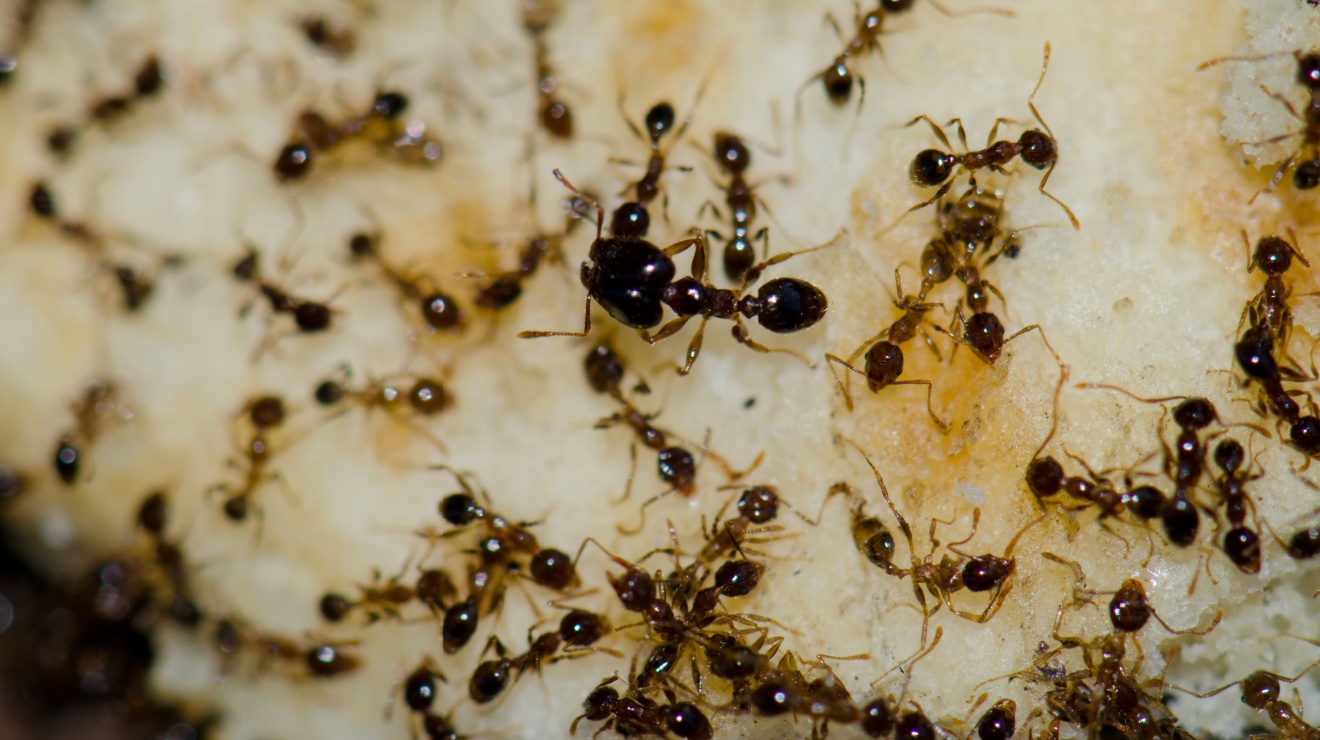
Not all ants are alike, and the Temecula Valley is home to several species that behave in different ways. Correctly identifying the ant is the first step toward controlling it, because the methods and baits that work on one species may do nothing to another. These are the ants Temecula homeowners encounter most often.
Argentine Ant
No ant causes more trouble in the Temecula Valley than the Argentine ant. Workers measure only about an eighth of an inch and wear a fairly uniform brown, moving in dense, well-defined lines. What sets the species apart is its structure: many queens share a single interconnected network that can span several yards at once. These ants forage heavily for sugars and water, which is why their trails so often lead straight to a kitchen sink or counter. That sprawling, multi-queen arrangement is also the reason they are so stubborn to clear out for good.
Fire Ants
Fire ants are a genuine concern in the Temecula Valley, and the area sees both the native southern fire ant and the invasive red imported fire ant. They are reddish to reddish-brown and often build mounds in lawns, garden beds, and open soil. Unlike many household ants, fire ants deliver a painful sting and will swarm out to defend their nest when it is disturbed. This makes them a safety issue, particularly in yards where children and pets play. A suspected fire ant mound is best left alone and handled by a professional, since disturbing it can provoke a large number of stings.
Odorous House Ant
At a glance, the odorous house ant is easy to mistake for the Argentine ant, since both are small and dark. The giveaway is scent, because crushing one releases a musty smell that many people compare to spoiled coconut. Like its look-alike, this species keeps several queens and will pick up and relocate its nest with little warning, which is why it can seem to vanish from one part of a house and turn up in another. It leans toward sweet foods and works its way into kitchens as readily as any ant on this list.
Pavement Ant
True to their name, pavement ants build their nests below hard surfaces, tunneling into the soil beneath driveways, patios, walkways, and slab foundations. They work their way indoors through the seams and cracks in that concrete, appearing most often in garages and kitchens. Their appetite runs more toward greasy and protein-based foods than toward sugars, which distinguishes their trails from those of the Argentine ant. With the nest tucked safely beneath solid hardscape, a pavement ant problem tends to hang on once it is established.
Carpenter Ant
Carpenter ants stand out for their size, running noticeably larger than the other ants on this list and usually dark in color. Termites feed on wood, but carpenter ants do not; instead, they hollow out galleries inside it to house their colony, favoring beams and trim that moisture has already weakened. Left alone, that hollowing can add up to genuine structural harm over a period of years. A common warning sign is a scattering of coarse, sawdust-like shavings beneath wood or along baseboards, usually noticed around the same time as unusually large ants indoors.
Identifying the species correctly makes all the difference in treating it. If ants have become a regular presence around your home, Bug Freedom Pest Control can identify the type and target the colony directly. Reach out for a free quote to get started.